Learn
Is 0.5% ABV really alcohol-free?
Dry Shelf Editorial · Updated · 6 min read
Quick answer
No. In the US a drink under 0.5% ABV is legally non-alcoholic, while alcohol-free and 0.0% are reserved for drinks with no alcohol. At the 0.5% ceiling a 12 oz can holds about 1.4 grams of ethanol, roughly a tenth of a standard drink, so pregnant people, people in recovery or on medication, and anyone avoiding alcohol for religious reasons should choose 0.0.
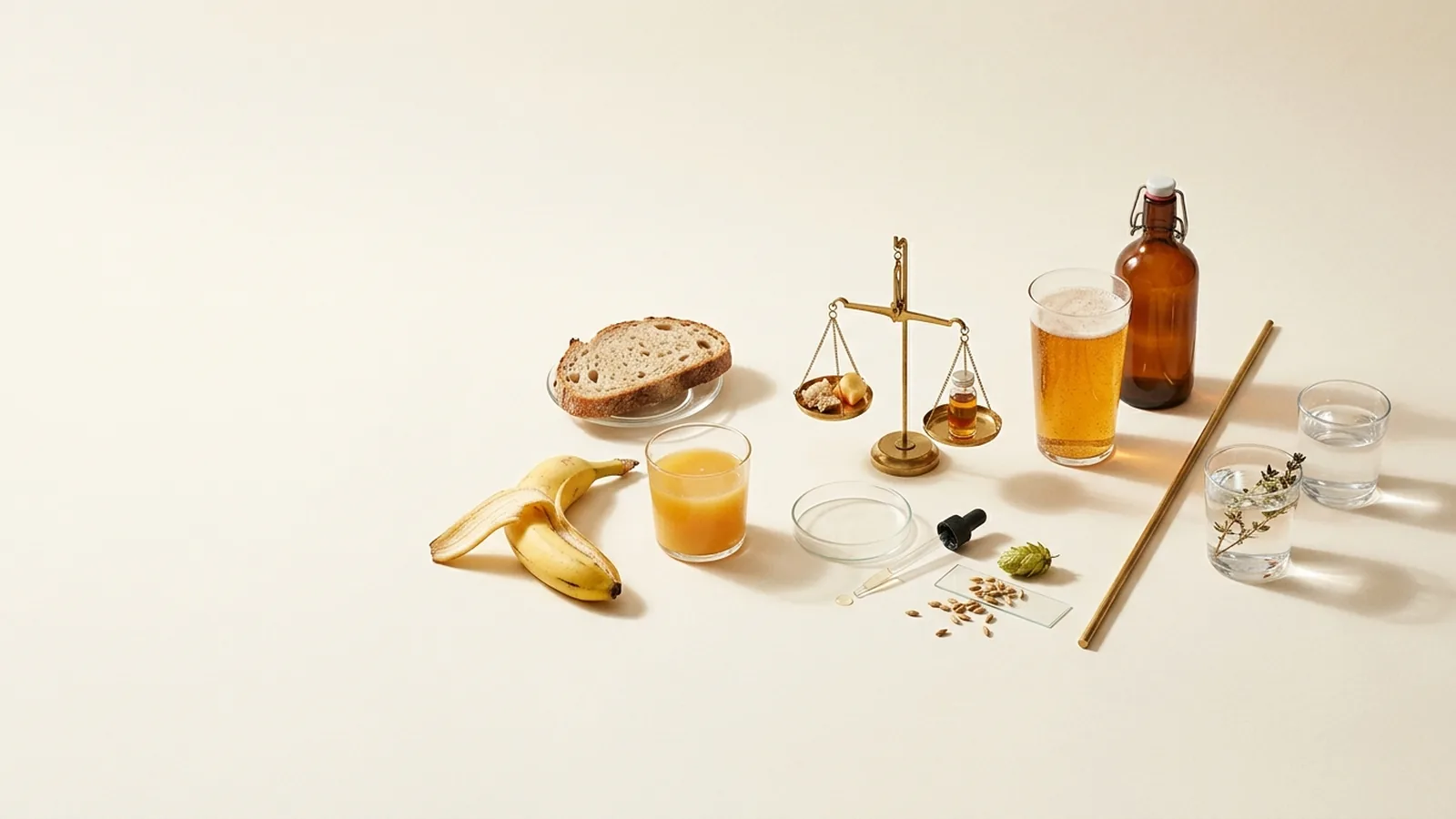
Key takeaways
- TTB rules: non-alcoholic means under 0.5% ABV; alcohol-free and 0.0% mean no alcohol at all.
- A 12 oz can at 0.5% holds at most about 1.4 g of ethanol, about one-tenth of a 14 g US standard drink.
- A 2016 lab study found up to 0.86 g of ethanol per liter in grape juice and 1.28 g per 100 g in burger rolls.
- Swiss and Canadian lab tests found some drinks over their label, mostly kombucha and flavored spirit alternatives.
- Choose 0.0 for pregnancy, recovery, medication, religious practice or EtG-monitored abstinence.
We research rather than taste-test: label data comes from brand pages checked . How we research
On this page6 sections
No. In the US, a drink with up to 0.5% ABV is legally non-alcoholic, not alcohol-free. Federal rules reserve "alcohol-free" for drinks with no alcohol at all, which is why a can of Heineken 0.0 and a can of Athletic Run Wild sit on the same shelf but carry different wording. For most adults the trace in a 0.5% beer is tiny, about a tenth of a standard drink at the very most. For a few groups, the difference matters, and they should buy 0.0.
What the US label rules actually say
The Alcohol and Tobacco Tax and Trade Bureau (TTB) writes the labeling rules for beer-style malt beverages. Its regulation, 27 CFR 7.65, sets three tiers:
| Label term | What it legally means | Tolerance |
|---|---|---|
| Alcohol free | Contains no alcohol | None |
| Non-alcoholic | Less than 0.5% ABV, and the words "contains less than 0.5 percent (or .5%) alcohol by volume" must sit right next to the term | Actual content may not exceed the labeled amount |
| Low alcohol / reduced alcohol | Less than 2.5% ABV | Must stay under 2.5% |
The same rule says a beer cannot be labeled "0.0%" unless it is also labeled "alcohol free" and contains no alcohol. So a true 0.0 claim is a stronger promise than "non-alcoholic", not a rounding of it.
Wine is different. Dealcoholized wine is labeled under FDA policy (CPG Sec. 510.400), which asks for the words "dealcoholized" or "alcohol-removed" in front of "wine", plus "contains less than 0.5 percent alcohol by volume". FDA allows "non-alcoholic" as an extra claim but says it does not treat "non-alcoholic" and "alcohol-free" as synonyms; "alcohol-free" is for products with no detectable alcohol.
Label check: "Zero proof", "NA" and "spirit-free" are marketing words. None of them is one of the defined terms in TTB's malt beverage rule. Look for the ABV statement instead.
Our full term-by-term guide is at how to read a non-alcoholic label, and the 0.0 or 0.5? label decoder turns any wording into a plain answer.
How much alcohol is 0.5%, really?
A US standard drink holds 14 grams of pure alcohol, per the National Institute on Alcohol Abuse and Alcoholism (NIAAA). The math on a 12 oz (355 ml) can at the 0.5% ceiling:
- 355 ml × 0.5% = about 1.8 ml of ethanol
- 1.8 ml × 0.79 g/ml = about 1.4 grams
- 1.4 g ÷ 14 g = about one-tenth of a standard drink, and that is the legal maximum, not the typical content
0.5% vs juice, bread and bananas
Ethanol forms naturally whenever sugars ferment, so ordinary food carries some. A 2016 study in the Journal of Analytical Toxicology by Gorgus, Hittinger and Schrenk measured supermarket foods in Germany by gas chromatography:
| Food tested | Ethanol measured | Same food per 12 oz / 100 g |
|---|---|---|
| Orange juice (5 brands) | 0.16–0.73 g per liter | up to about 0.26 g per 12 oz glass |
| Grape juice (3 brands) | 0.29–0.86 g per liter | up to about 0.31 g per 12 oz glass |
| Apple juice (5 brands) | 0.06–0.66 g per liter | up to about 0.23 g per 12 oz glass |
| Very ripe banana | 0.04 g per 100 g | 0.04 g per 100 g |
| American-style burger rolls | 1.28 g per 100 g | 1.28 g per 100 g |
| A 0.5% beer, for comparison | up to 3.9 g per liter | up to about 1.4 g per 12 oz can |
Two honest readings of that table. First, a 0.5% beer at its ceiling holds more ethanol than juice, roughly four to five times the strongest juice tested. Second, it is in the same range as some everyday bread: 100 grams of the burger rolls carried almost as much as a full can. The authors estimated a 6-year-old eating normal amounts of these foods takes in about 10 mg of ethanol per kg of body weight per day. The study was partly funded by a herbal-medicine company, which the paper discloses.
Note: Your liver processes this trace ethanol as it arrives. In a German experiment published in Forensic Science International (Thierauf and colleagues, 2010), volunteers drank about 2.5 liters of non-alcoholic beer and their blood and urine ethanol tests stayed negative.
Does the label match the can?
Mostly, but not always. Two sets of lab tests are worth knowing:
- Canton of Zurich, 2022. The Swiss cantonal lab tested 25 drinks sold as alcohol-free (Swiss law allows up to 0.5% under that term). Five exceeded their label: a gin alternative at 0.6%, two kombuchas at about 1.5%, and two products sold as "0.0%" that contained 0.1% and 0.6%, the alcohol coming from flavorings.
- British Columbia kombucha, 2021. A study in the Journal of Food Protection (Jang and colleagues) measured 684 kombucha samples. About 31.5% were above the province's 1% limit for non-alcoholic drinks, and four exceeded 3%.
The pattern: beer and wine made in big, controlled plants rarely drift, while live-fermented drinks can keep fermenting after bottling. TTB itself says refrigeration is not an adequate way to make sure a kombucha's alcohol does not rise. See our kombucha alcohol guide.
Watch out: The Thierauf study also found that NA beer can trigger a positive urine test for ethyl glucuronide (EtG), the marker used in abstinence monitoring. Several volunteers exceeded the common 0.1 mg/L cut-off. If you are in a monitored program, that alone is a reason to choose 0.0.
Who should choose 0.0 instead
For most adults, 0.5% is a practical non-issue. These groups have a real reason to buy 0.0 or a drink with no fermentation at all:
- Pregnancy. The CDC says there is no known safe amount of alcohol during pregnancy and that all types, including beer, can be harmful. See our pregnancy drinks guide.
- Recovery. The trace is not the main risk; the taste and ritual of beer can be a cue. A 0.0 removes one variable.
- Medication. Some medicines interact with alcohol, and the label is the only measure you get.
- Religious practice. Many people who avoid alcohol for faith reasons treat any intentional alcohol as off-limits, and only "alcohol free" or "0.0" promises none.
- Monitored abstinence. EtG tests can flag NA beer, as above.
If any of these apply to you, ask your clinician which products fit your situation.
Tip: Widely sold 0.0 beers include Heineken 0.0, Budweiser Zero and Michelob Ultra Zero. The US Guinness 0 is sold as non-alcoholic (under 0.5%), so it is not in that group despite the name.
What "0.5%" means in daily life
- Driving: the trace in NA beer did not register in blood in the Thierauf experiment, but that is one small study, so treat any drink as a decision, not a loophole.
- Calories: both 0.0 and 0.5 beers are usually far lighter than regular beer. See NA beer calories.
- Choosing: browse all NA beers, or our best 0.0 beers.
Bottom line: 0.5% is non-alcoholic, not alcohol-free. It is a legal ceiling of about a tenth of a drink, comparable to some bread and a few times stronger than juice. If you need zero, buy a label that says "alcohol free" or "0.0%".
Questions
Does non-alcoholic beer have alcohol?
Usually a trace. In the US, non-alcoholic beer can contain up to 0.5% ABV, about 1.4 grams of ethanol in a 12 oz can at most. Only beers labeled alcohol free or 0.0% promise none.
What does zero proof mean?
Zero proof is a marketing phrase for drinks made to replace alcoholic ones. It is not one of the terms defined in the federal malt beverage labeling rule, so check the ABV statement on the label to see whether the drink is 0.0% or under 0.5%.
Can you get drunk on 0.5% beer?
In practice, no. At the legal ceiling a 12 oz can holds about a tenth of a standard drink, and volunteers who drank about 2.5 liters of NA beer in a 2010 German study had negative blood ethanol tests.
Is 0.5% beer OK during pregnancy?
The CDC says there is no known safe amount of alcohol during pregnancy. If you want to avoid alcohol entirely, choose drinks labeled alcohol free or 0.0% and avoid live-fermented drinks such as kombucha.
Is 0.5% ABV the same as 0.5 proof?
No. Proof in the US is twice the ABV, so 0.5% ABV is 1 proof.
Keep going
Tool
0.0 or 0.5? Label decoder →
Tool
Label compare →
Read next
How to read a non-alcoholic label
Read next
How much alcohol is in kombucha?
Read next
Non-alcoholic beer calories and carbs: 20 brands compared
Read next
Is non-alcoholic beer bad for you?
Read next
Near beer: from Prohibition to the NA boom
From the blog
Non-alcoholic white elephant gifts: 10 bottles worth stealing
From the blog
Christmas mocktails: 10 festive recipes, measured
Sources
- 1.TTB — Malt beverage alcohol content labeling
- 2.27 CFR 7.65 — Alcohol content statements (Cornell LII)
- 3.FDA CPG Sec. 510.400 — Dealcoholized wine and malt beverages labeling
- 4.Gorgus, Hittinger & Schrenk (2016), Estimates of ethanol exposure in children from food not labeled as alcohol-containing, J Anal Toxicol
- 5.Thierauf et al. (2010), Urine tested positive for EtG and EtS after consumption of non-alcoholic beer, Forensic Sci Int
- 6.Kanton Zürich (2022) — lab test of 25 alcohol-free drinks
- 7.Jang et al. (2021), Ethanol concentration of kombucha teas in British Columbia, J Food Prot
- 8.TTB — Kombucha general information
- 9.NIAAA — What is a standard drink?
- 10.CDC — About alcohol use during pregnancy